Merit Award: Research
Best Practice Guidelines for Sporting Fields: A guide for climate-resilient playing surfaces – New South Wales, Australia
SUBMITTED BY
Paul Lamble, Peak Water Consulting
PROJECT OVERVIEW
• NSW sporting fields face increasing pressure from population growth, usage, and limited resources
• Industry often misattributes poor turf conditions to overuse or lack of irrigation
• Developed Best Practice Guidelines to improve performance, sustainability, and water efficiency
• Focus on optimizing water use, field resilience, and long-term community outcomes
RESEARCH APPROACH
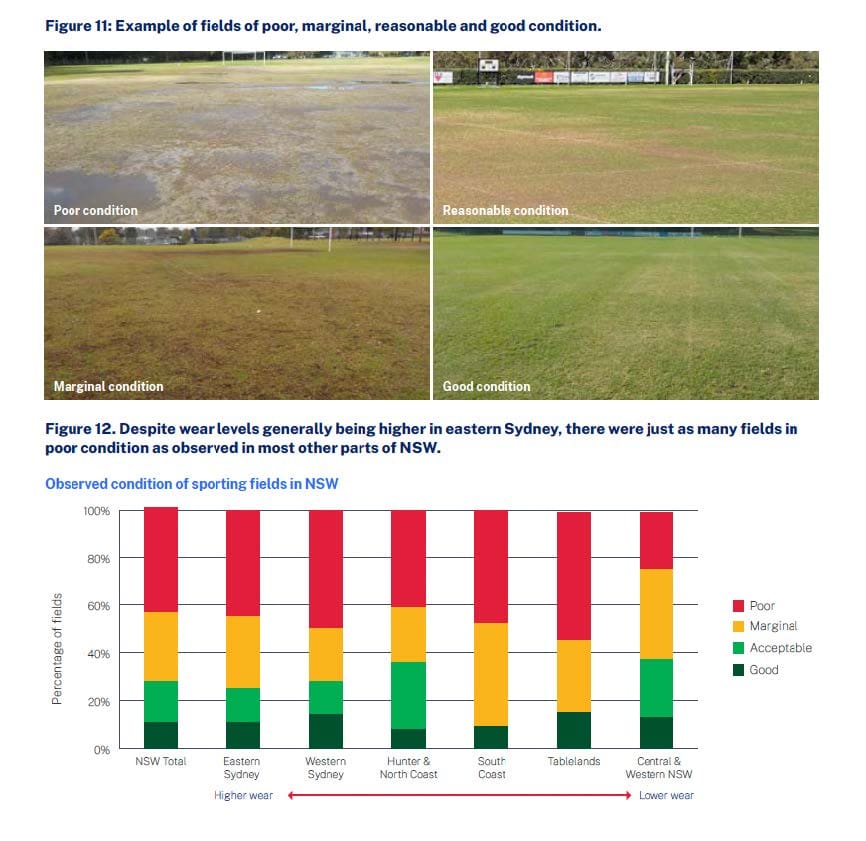
• Assessed irrigation performance (~100 fields) and field conditions (~2,000 sites)
• Modeled water balance and turf stress over 23 years across 21 climate zones
• Analyzed drought resilience, carrying capacity, and field design types
• Integrated 15+ years of industry experience
KEY FINDINGS
• Irrigation needs vary significantly by region
• Most systems are inefficient, with poor uniformity and outdated practices
• Field condition is driven by soil, turf, and maintenance—not wear
• High-performing fields use less water than industry standards
• Well-designed natural turf fields are both durable and drought-resilient
BEST PRACTICE PRINCIPLES
• Align turf, soil, and drainage with site conditions
• Optimize irrigation efficiency and system performance
• Maintain proactive management and balanced field use
• Design for durability, water efficiency, and climate resilience
IMPACT & SIGNIFICANCE
• Challenges industry assumptions about water use and turf performance
• Shows that design and management—not more water—drive outcomes
• Provides a scalable model for sustainable, high-performing sports fields